Click here to see Table of Contents
If you are starting with IoT, home automation, Wi-Fi projects, sensors, smart switches, or connected devices, two microcontrollers you will come across again and again are the ESP8266 and ESP32.
Both are affordable Wi-Fi-enabled microcontrollers that can connect directly to your wireless network, making them extremely popular for DIY electronics and IoT projects. But the ESP32 is newer and considerably more powerful, while the ESP8266 remains an excellent choice for simple and low-cost Wi-Fi projects.
So, ESP8266 vs ESP32 — which one should you choose?
The answer depends on what you are building.
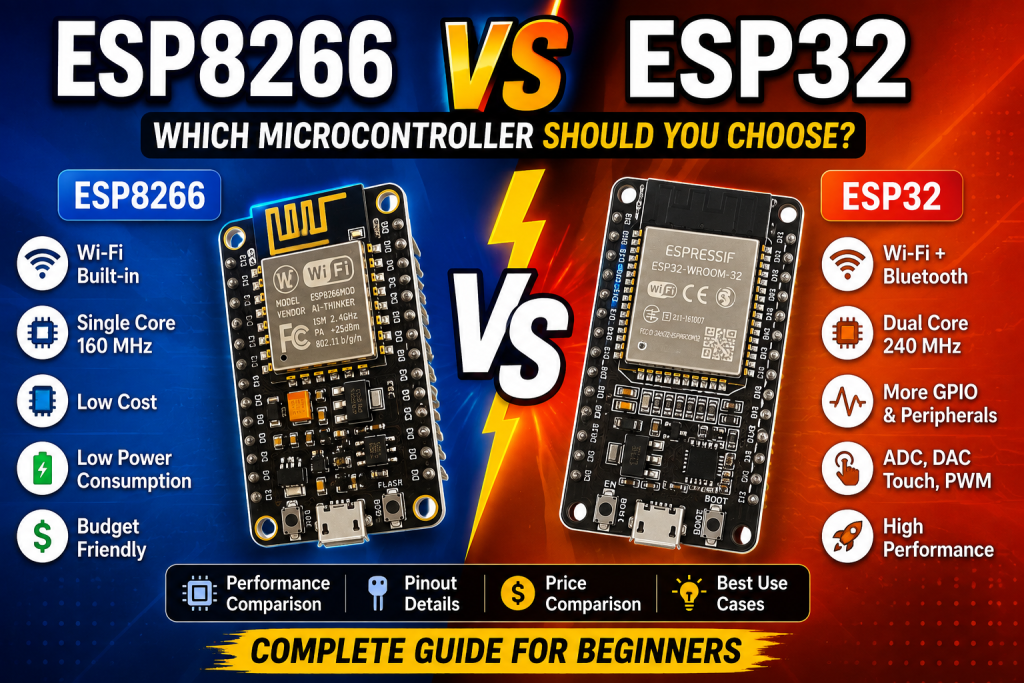
In this guide, we will compare the ESP8266 and ESP32, including their specifications, GPIO pins, Wi-Fi and Bluetooth capabilities, processing power, memory, ADC, PWM, power consumption, price, pinout considerations, and real-world project applications.
What Is ESP8266?
The ESP8266 is a low-cost Wi-Fi-enabled microcontroller originally developed by Espressif. It became extremely popular among makers because it combines a microcontroller and Wi-Fi connectivity in a small and inexpensive chip.
Before ESP8266 boards became popular, adding Wi-Fi to an Arduino project generally required an additional Wi-Fi module. The ESP8266 changed this by putting Wi-Fi connectivity directly into the microcontroller platform.
Popular ESP8266 development boards include:
- NodeMCU ESP8266
- Wemos D1 Mini
- ESP-01
- ESP8266 development boards
The ESP8266 is particularly useful for projects where you need Wi-Fi, GPIO control, sensors, web servers, MQTT, HTTP communication, or simple automation without requiring a large amount of processing power.
ESP8266 is suitable for projects such as:
- Wi-Fi smart switches
- IoT sensors
- Temperature and humidity monitoring
- Wi-Fi-controlled relays
- Simple web servers
- MQTT devices
- Smart lighting
- Water tank monitoring
- Home automation
- Internet-connected sensors
- Simple data loggers
What Is ESP32?
The ESP32 is a more powerful family of microcontrollers from Espressif. It improves significantly upon the ESP8266 by providing more processing power, more GPIO capabilities, Bluetooth support, more peripherals, and greater flexibility.
Depending on the ESP32 variant, you can get features such as:
- Wi-Fi
- Bluetooth
- Bluetooth Low Energy (BLE)
- Dual-core processing
- More GPIO
- More ADC channels
- DAC
- Touch sensing
- Multiple communication interfaces
- Higher processing performance
Popular ESP32 boards include:
- ESP32 DevKit
- ESP32-WROOM development boards
- ESP32-S3 boards
- ESP32-C3 boards
- ESP32-C6 boards
Because there are many ESP32 variants, the exact specifications can differ between boards and chips. Therefore, it is important to check the specific ESP32 model before designing hardware around it.
ESP8266 vs ESP32: Quick Comparison
Here is a simplified comparison of the commonly used ESP8266 and original ESP32-class development boards.
| Feature | ESP8266 | ESP32 |
|---|---|---|
| Manufacturer | Espressif | Espressif |
| Wi-Fi | Yes | Yes |
| Bluetooth | No | Yes |
| Typical CPU | 32-bit Tensilica L106 | 32-bit Tensilica LX6 |
| CPU frequency | Up to 160 MHz | Up to 240 MHz |
| CPU cores | Single-core | Dual-core |
| SRAM | Around 160 KB* | Around 520 KB* |
| Flash | Board dependent | Board dependent |
| GPIO | Fewer | More |
| ADC | 10-bit | Up to 12-bit |
| DAC | No | Yes, on classic ESP32 |
| Touch sensing | No | Yes, on supported variants |
| PWM | Yes | Yes |
| UART | Yes | Multiple |
| SPI | Yes | Multiple |
| I²C | Yes | Yes |
| Bluetooth | No | Yes |
| Power | Generally lower complexity | More capable, potentially higher consumption |
| Cost | Usually cheaper | Usually more expensive |
| Processing capability | Basic to moderate | High |
| Best for | Simple Wi-Fi IoT | Advanced IoT and connected devices |
*Exact memory and peripheral availability varies by chip variant and board.
ESP8266 vs ESP32: Similarities
Despite their differences, the ESP8266 and ESP32 have many things in common.
1. Both Have Built-in Wi-Fi
One of the biggest advantages of both platforms is integrated Wi-Fi.
You can connect your project to a wireless network and communicate with:
- Web servers
- MQTT brokers
- REST APIs
- Cloud services
- Mobile applications
- Other IoT devices
This makes both platforms excellent for IoT development.
2. Both Can Be Programmed Using Arduino IDE
Beginners can program both ESP8266 and ESP32 boards using the Arduino IDE.
This makes the transition from Arduino boards relatively easy.
You can write code such as:
void setup() {
  pinMode(LED_BUILTIN, OUTPUT);
}

void loop() {
  digitalWrite(LED_BUILTIN, LOW);
  delay(500);

  digitalWrite(LED_BUILTIN, HIGH);
  delay(500);
}
The programming experience is similar, although libraries and hardware capabilities can differ between platforms.
3. Both Support Common IoT Protocols
Both platforms can be used with technologies such as:
- HTTP
- HTTPS
- MQTT
- WebSockets
- TCP/IP
- UDP
This makes them suitable for building connected devices and local web interfaces.
4. Both Support GPIO
GPIO pins allow the microcontroller to interact with external hardware.
You can connect:
- LEDs
- Relays
- Buttons
- Sensors
- Displays
- Motors through drivers
- Actuators
- Other electronic modules
However, the number and capabilities of GPIO pins are different, which is an important consideration when choosing between ESP8266 and ESP32.
ESP8266 Pinout
The ESP8266 itself has a different pin arrangement depending on the module or development board.
For example, the popular NodeMCU ESP8266 development board exposes GPIO pins using labels such as:
- D0
- D1
- D2
- D3
- D4
- D5
- D6
- D7
- D8
The image below shows the corresponding digital pin to actual GPIO numbers.
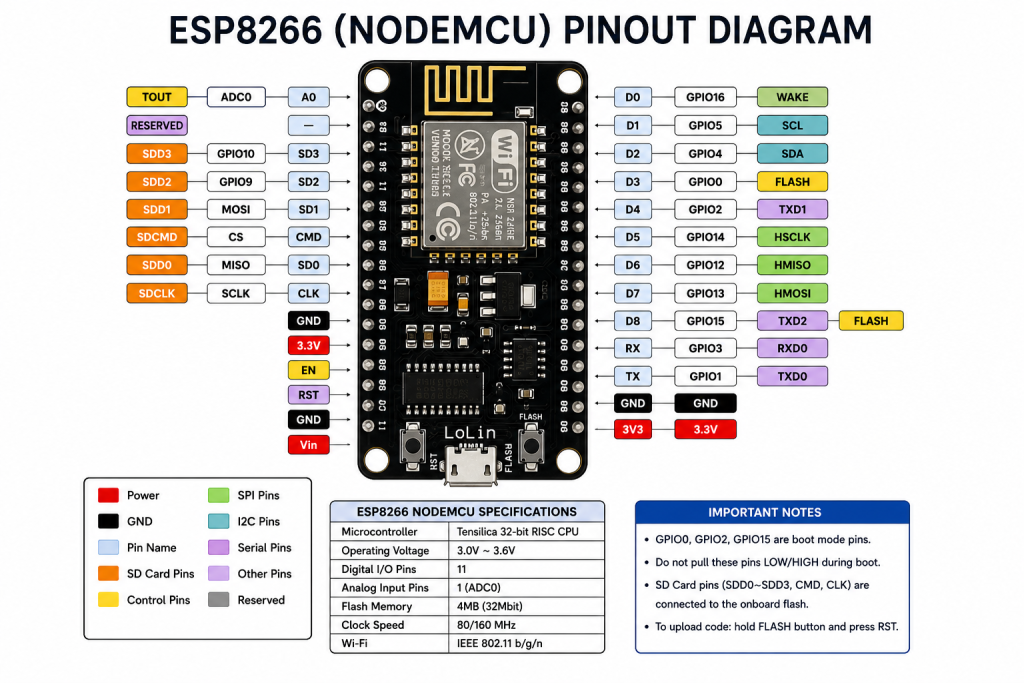
When writing portable ESP8266 code, it is often useful to understand the actual GPIO number rather than relying only on the board’s D-label.
Important ESP8266 GPIO considerations
Some ESP8266 pins have special functions during boot.
For example, GPIO0, GPIO2 and GPIO15 participate in the boot configuration of the ESP8266.
Therefore, connecting external hardware incorrectly to these pins can prevent the board from booting normally.
This is particularly important when designing relay boards, sensor circuits, and custom PCBs.
ESP32 Pinout
The ESP32 generally provides considerably more GPIO flexibility than the ESP8266.
A typical ESP32 development board exposes GPIO pins such as:
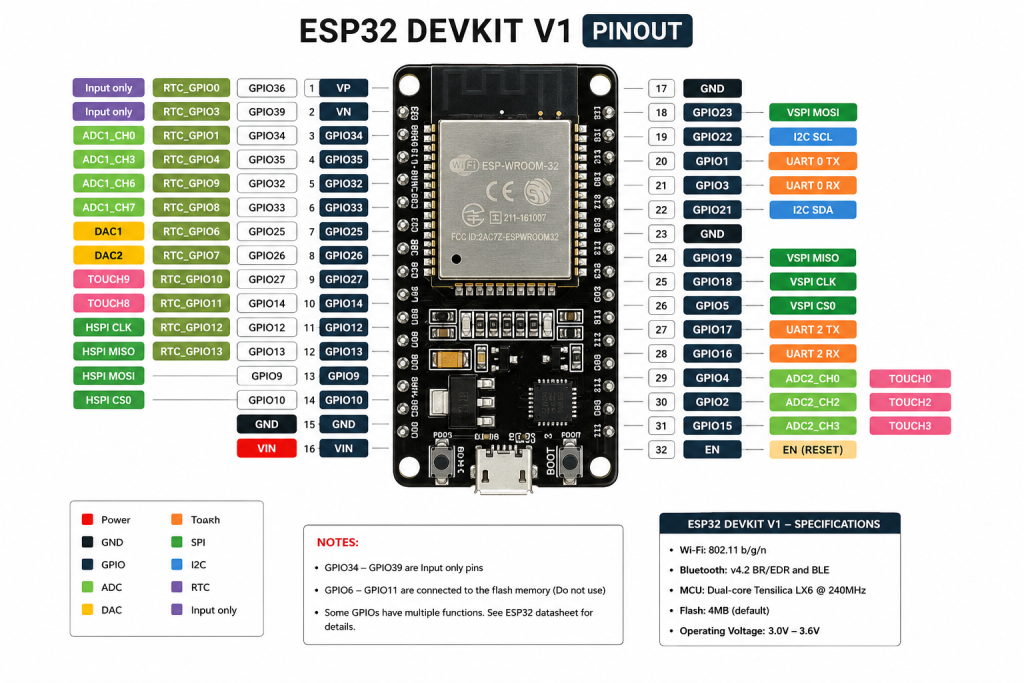
However, not every ESP32 board exposes every GPIO, and some GPIOs have restrictions.
For example, some GPIOs are input-only, some are connected to flash or PSRAM on particular variants, and some have boot-strapping functions.
Therefore, always check the pinout for your exact ESP32 board.
ESP8266 vs ESP32 Processing Power
One of the biggest differences is processing performance.
The ESP8266 uses a single-core processor that can operate at up to around 160 MHz.
The original ESP32 provides a substantially more powerful dual-core processor with frequencies up to 240 MHz.
This additional processing capability becomes useful when your project needs to perform several tasks simultaneously.
For example, an ESP32 can handle a combination of:
- Wi-Fi communication
- Bluetooth/BLE
- Sensor processing
- Web server
- Display
- Audio processing
- Multiple peripherals
with considerably more resources than an ESP8266.
For simple applications, however, the additional performance may not provide any practical benefit.
ESP8266 vs ESP32 Memory
Memory is another important difference.
The ESP32 generally provides substantially more SRAM than the ESP8266.
More memory is useful when your application contains:
- Large web interfaces
- JSON data
- Multiple network connections
- Buffers
- Audio processing
- Complex libraries
- Larger programs
- Multiple concurrent tasks
If your project is simply reading a sensor and sending the result through MQTT every few seconds, the ESP8266 can be more than sufficient.
ESP8266 vs ESP32 Wi-Fi
Both microcontrollers support Wi-Fi, which is one reason they are so popular.
For ordinary IoT applications, either platform can work very well.
Examples include:
ESP8266 → Wi-Fi → MQTT Broker
ESP32   → Wi-Fi → Web Server
ESP8266 → Wi-Fi → Cloud API
ESP32   → Wi-Fi → Mobile App
The choice therefore does not normally come down to whether Wi-Fi is available.
Instead, consider what you need in addition to Wi-Fi.
ESP32 Has Bluetooth
This is one of the most important advantages of the ESP32.
The ESP8266 does not provide Bluetooth connectivity.
Many ESP32 variants support Bluetooth or Bluetooth Low Energy, depending on the specific chip.
This opens the door to projects such as:
- Bluetooth sensors
- BLE beacons
- Bluetooth controllers
- Wireless configuration
- Smartphone-connected devices
- BLE keyboards and peripherals
- Bluetooth-based automation
If Bluetooth is required, an appropriate ESP32 variant is generally the better starting point.
ADC: ESP8266 vs ESP32
Analog input is another area where the ESP32 generally provides greater flexibility.
The ESP8266 has a single ADC input, while many classic ESP32 devices provide multiple ADC channels with higher resolution.
This matters when your project needs to measure multiple analog signals.
For example:
- Battery voltage
- Light intensity
- Potentiometers
- Analog sensors
- Soil moisture
- Current sensors
- Analog gas sensors
If you need several analog inputs, the ESP32 is usually a much better choice.
ESP32 DAC
Classic ESP32 devices also provide DAC functionality, which is not available on the ESP8266 in the same way.
A DAC can be useful for applications involving analog voltage generation and certain audio applications.
However, remember that ESP32 variants are not identical. Newer ESP32 families can have different peripheral sets, so always verify the datasheet for the exact chip.
ESP8266 vs ESP32 Power Consumption
Power consumption depends heavily on the board, Wi-Fi usage, CPU frequency, peripherals, sleep mode, and software.
The ESP8266 can be an excellent choice for simple battery-powered IoT applications, especially when deep sleep is used appropriately.
The ESP32 also has several low-power modes and can be extremely efficient when designed correctly.
However, the ESP32 provides substantially more hardware capabilities, so a complete ESP32 project can consume more power depending on what features are enabled.
For battery projects, don’t choose solely based on the microcontroller. Consider the entire board design, regulator, sensors, LEDs, USB interface, and wireless usage.
ESP8266 vs ESP32 Price
Price varies significantly depending on the board, seller, module, memory configuration, and country.
In general:
ESP8266 development boards are cheaper.
ESP32 development boards are usually more expensive.
The difference can become important when you are building dozens or hundreds of devices.
For example, if your application only needs:
- One sensor
- Wi-Fi
- A few GPIO pins
- Simple MQTT communication
there may be little reason to spend extra money on a more powerful ESP32.
But for a sophisticated IoT product, the additional capabilities of ESP32 can easily justify the higher board cost.
Which Is Better: ESP8266 or ESP32?
There is no universal winner.
The better microcontroller depends on your project.
Choose ESP8266 when:
- You need Wi-Fi.
- You want a very inexpensive board.
- Your project has relatively simple processing requirements.
- You only need a small number of GPIO pins.
- You don’t need Bluetooth.
- You don’t need many analog inputs.
- You are building a basic IoT sensor.
- You want a simple Wi-Fi web server.
Choose ESP32 when:
- You need Bluetooth or BLE.
- You need more GPIO pins.
- You need multiple analog inputs.
- You need greater processing power.
- You need more memory.
- You need multiple peripherals.
- You are processing audio.
- You are building a more complex web interface.
- You need multiple simultaneous tasks.
- You expect your project to grow in complexity.
ESP8266 or ESP32 for Different Projects
| Project | Recommended |
|---|---|
| Simple Wi-Fi LED | ESP8266 |
| Wi-Fi relay | ESP8266 |
| Wi-Fi temperature sensor | ESP8266 |
| MQTT sensor | ESP8266 |
| Smart switch | ESP8266 |
| Water tank monitor | ESP8266 |
| Wi-Fi web server | ESP8266 / ESP32 |
| Battery IoT sensor | ESP8266 / ESP32 |
| Bluetooth project | ESP32 |
| BLE sensor | ESP32 |
| Audio project | ESP32 |
| Multiple analog sensors | ESP32 |
| Complex automation | ESP32 |
| Camera project | ESP32 variant |
| Advanced IoT gateway | ESP32 |
| Wi-Fi + Bluetooth device | ESP32 |
| High-performance IoT project | ESP32 |
Can ESP8266 Be Used for IoT in 2026?
Yes.
Although ESP32 is more capable, the ESP8266 remains useful for many projects.
If you are building a simple Wi-Fi-connected device, the ESP8266 can still provide excellent value.
For example, imagine a Wi-Fi water tank monitor.
You could use:
Ultrasonic Sensor
       ↓
   ESP8266
       ↓
      Wi-Fi
       ↓
   MQTT / Web UI
There is no need for a powerful processor if the device only measures water level and sends the result over Wi-Fi.
Using ESP32 for such a project would work too, but the extra processing power may not be necessary.
When Should You Start Directly With ESP32?
If you are beginning a new project and are unsure whether you will need additional capabilities, ESP32 is often the safer choice.
Its additional GPIO, memory, processing power, Bluetooth capabilities, and peripheral options give you more room to expand your project.
For example, you might initially build:
Temperature Sensor
        ↓
      ESP32
        ↓
       Wi-Fi
Later, you may want to add:
Temperature
Humidity
Display
Bluetooth
Web Server
Relay
OTA Updates
        ↓
      ESP32
        ↓
       Wi-Fi
The ESP32 gives you considerably more room for this kind of expansion.
ESP8266 vs ESP32: The Simple Decision
If you want the simplest possible rule, use this:
Choose ESP8266 for simple, low-cost Wi-Fi projects.
Choose ESP32 for more advanced projects that need additional processing power, GPIO, analog inputs, Bluetooth, or peripherals.
You don’t necessarily need the most powerful microcontroller for every project.
A good engineering decision is to select the least expensive and simplest hardware that comfortably meets your requirements.
Final Verdict
The ESP8266 and ESP32 are both excellent microcontrollers for IoT and connected electronics projects, but they target slightly different requirements.
The ESP8266 is inexpensive, compact, Wi-Fi capable, and powerful enough for many everyday IoT applications.
The ESP32 takes the concept further with significantly greater processing capability, more GPIO and peripherals, Bluetooth/BLE support on appropriate variants, and more memory.
For a basic Wi-Fi sensor, smart switch, relay controller, MQTT device, or simple web server, ESP8266 remains an excellent choice.
For Bluetooth projects, audio applications, complex automation, multiple sensors, advanced web interfaces, and projects requiring more processing power, ESP32 is generally the better choice.
The most important point is this:
Don’t choose ESP32 simply because it is more powerful. Choose the microcontroller that matches your project’s actual requirements.
If you are just starting with ESP development, learning both is valuable. Start with a simple ESP8266 project to understand Wi-Fi, GPIO, sensors, and web communication, then move to ESP32 when your projects require more processing power and hardware capabilities.
Frequently Asked Questions
Is ESP32 better than ESP8266?
ESP32 is more capable overall, with greater processing power, more memory, more GPIO options, and Bluetooth/BLE on supported variants. However, ESP8266 can be the better choice for simple and inexpensive Wi-Fi projects.
Is ESP8266 still worth using?
Yes. ESP8266 remains useful for many simple IoT applications where Wi-Fi connectivity and low cost are more important than advanced peripherals.
Can ESP8266 and ESP32 use the Arduino IDE?
Yes. Both platforms can be programmed using the Arduino IDE with their respective board packages.
Does ESP8266 have Bluetooth?
No. The ESP8266 does not have built-in Bluetooth. If Bluetooth or BLE is required, an appropriate ESP32 variant is a better choice.
Which is cheaper, ESP8266 or ESP32?
ESP8266 development boards are generally cheaper, although actual prices depend on the board model, seller, memory configuration, and market.
Which is better for IoT?
Both are excellent for IoT. ESP8266 is suitable for simple Wi-Fi IoT devices, while ESP32 is better for more complex IoT applications requiring additional processing power, GPIO, peripherals, or Bluetooth.
Which is better for beginners?
Both are beginner-friendly when used with the Arduino IDE. ESP8266 is a good starting point for basic Wi-Fi projects, while ESP32 provides more capabilities to explore as your projects become more advanced.
Related ESP Projects
Once you understand the differences between ESP8266 and ESP32, you can start building practical projects such as:
- ESP8266 Wi-Fi Smart Switch
- ESP32 Bluetooth Controller
- ESP8266 MQTT Sensor
- ESP32 Web Server
- ESP8266 Water Tank Monitor
- ESP32 IoT Sensor
- ESP32 Home Automation System
- ESP8266 OTA Update System
Learning by building real projects is one of the fastest ways to understand the ESP platform.
Start with a simple project, understand the GPIO and networking fundamentals, and gradually move toward more advanced ESP8266 and ESP32 applications.
Related ESP8266 Projects
Want to put your ESP8266 knowledge into practice? Check out these practical ESP8266 projects from ESPStudio:
🔌 ESP8266 Smart Wi-Fi Switch
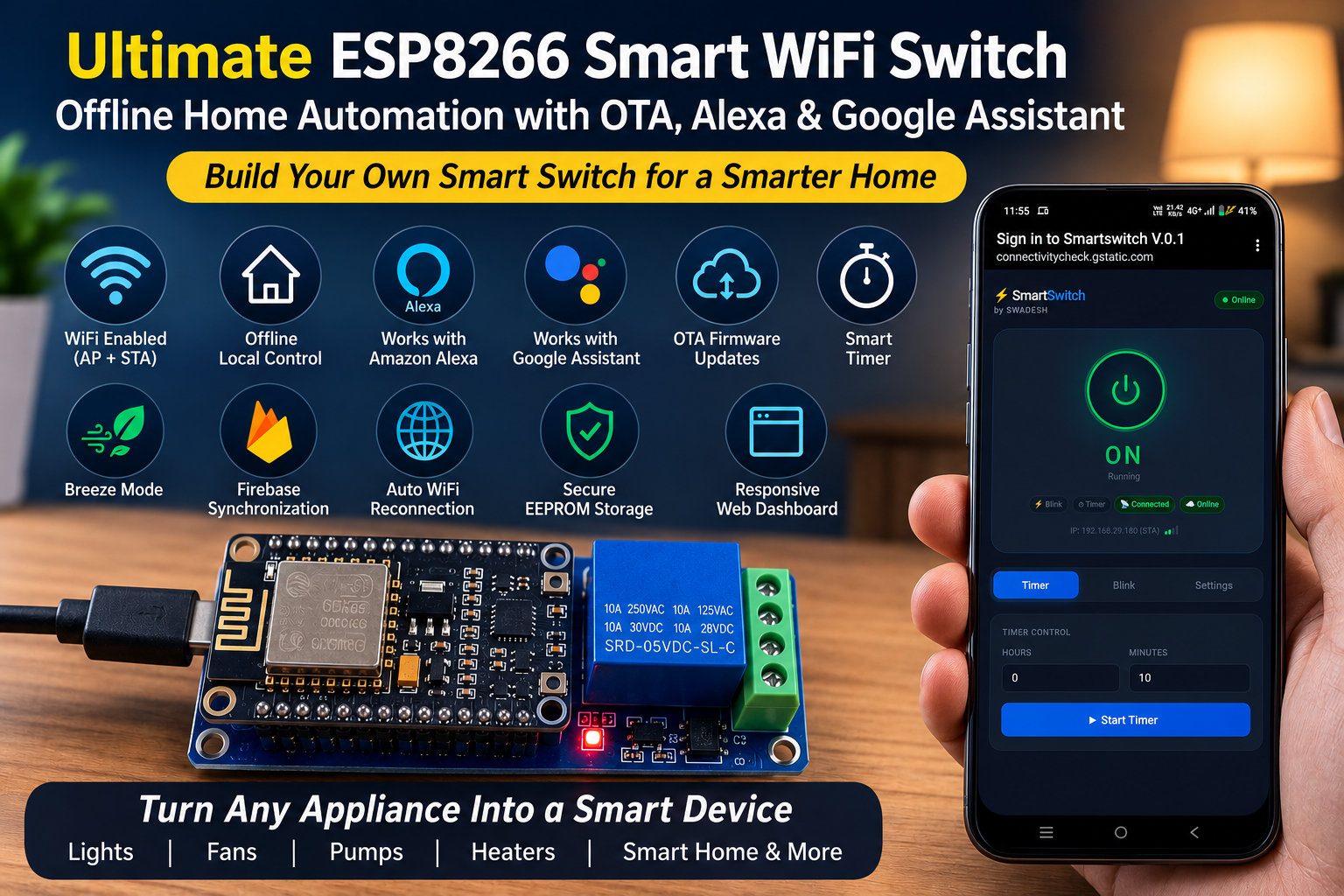
Learn how to build an ESP8266 Wi-Fi smart switch that lets you control electrical appliances through a web-based interface. This project is a great starting point for learning ESP8266 GPIO control, Wi-Fi connectivity, and home automation.
Explore the project: ESP8266 Smart Wi-Fi Switch
📡 ESP8266 Wi-Fi Extender
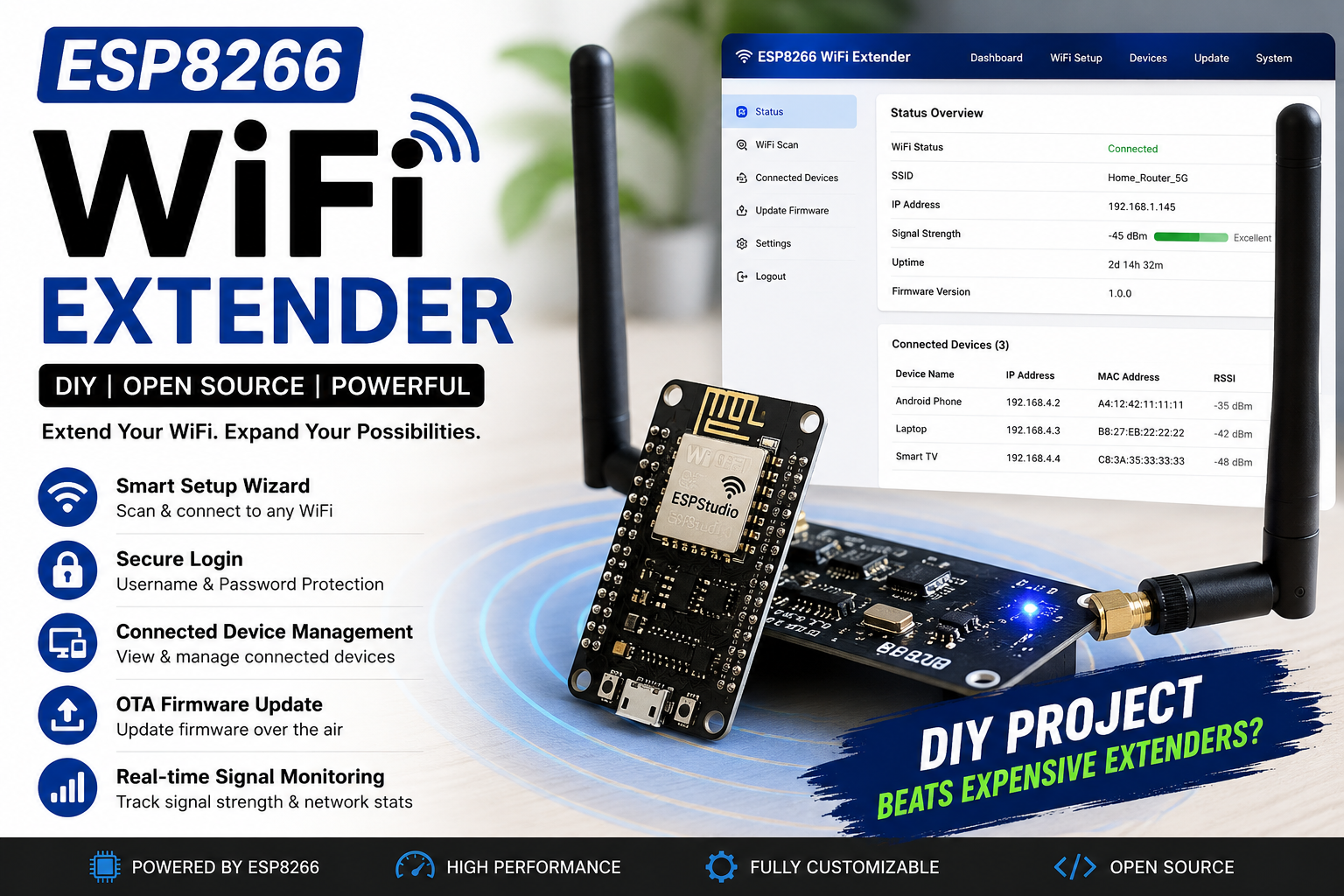
Learn how to build an ESP8266 Wi-Fi extender and explore how the ESP8266 can be used for Wi-Fi networking applications. This project is useful for understanding the networking capabilities of the ESP8266 and experimenting with wireless connectivity.
Explore the project: ESP8266 Wi-Fi Extender
Explore more ESP8266 and ESP32 projects on ESPStudio to learn through practical electronics, IoT, Wi-Fi, and home automation projects.